
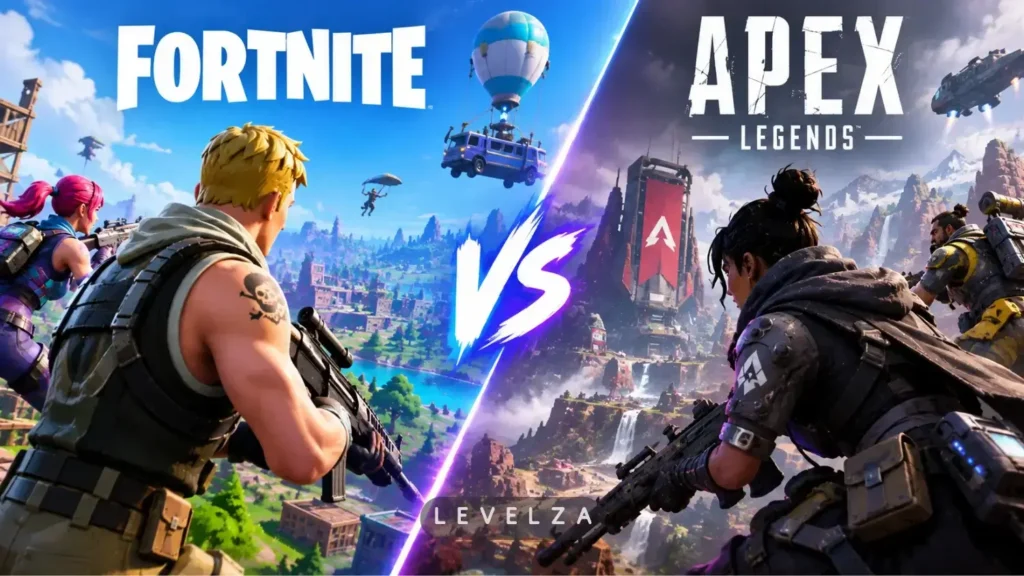


Weighing fortnite vs apex legends is no longer a question of visual style. It is a choice between two opposed combat philosophies. One grew from an experimental building shooter into a multi-genre platform, and the other stayed a high-tempo first-person arena built on gun mastery and character synergy.
LEVELZA dissects the operational differences between Fortnite and Respawn’s hero shooter across engine behavior, movement, time-to-kill, and long-term live-service value.
Quick Verdict: Core Mechanical Matchup
- Primary Divergence: Perspective and pacing. Fortnite is a third-person sandbox built around structural manipulation, while Apex Legends is a first-person shooter built around kinetic slide-hopping and squad ability synergy.
- Skill Ceiling Target: Fortnite centers on rapid spatial editing or tactical positioning in Zero Build. Apex Legends centers on recoil tracking, movement tech, and cooldown management.
- Platform Footprint: Fortnite reaches further through native mobile deployment, cloud streaming, and its sandbox sub-games. Apex Legends delivers a dedicated competitive shooter on desktop and console.
Fortnite vs Apex Legends: Head-to-Head Comparison Matrix
| Feature / Dimension | Fortnite | Apex Legends | LEVELZA Analysis & Verdict |
|---|---|---|---|
| Core Engine & Visual Architecture | Unreal Engine 5 with Nanite geometry, Lumen dynamic lighting, and multiple rendering paths. | A heavily modified Source Engine foundation, customized for fast movement and responsive netcode. | Fortnite Wins: Unreal Engine 5 offers broader graphical scalability and modular asset streaming, which lets one client serve very different hardware tiers. |
| Perspective & Gunplay Physics | Third-person over-the-shoulder view, with hitscan weapons, projectile ballistics, and bloom mechanics. | First-person view, with projectile drop, distinct recoil patterns, and tight hipfire spread. | Apex Legends Wins: Recoil patterns that can be learned and repeated give Apex a more tactile, predictable gunplay loop. |
| Movement Mechanics & Kinetic Mobility | Tactical sprint, sliding, mantling, and traversal items. | Momentum-based sliding, wall-bouncing, tap-strafing, zipline dancing, and legend-specific mobility kits. | Apex Legends Wins: Momentum carries between movement actions, which raises the skill-expression ceiling well above Fortnite’s more structured traversal. |
| Mode Variety & Gameplay Flexibility | Battle Royale with building, Zero Build, LEGO Fortnite, Rocket Racing, Festival, and UEFN creator maps. | Trios and Duos Battle Royale, ranked play, and rotating arcade modes. | Fortnite Wins: Creator-built experiences extend the platform far beyond what a single studio can ship, and Zero Build covers traditional shooter fans. |
| Time-to-Kill & Engagement Pacing | Low to moderate time-to-kill, with sniper one-shots and high-burst shotguns allowing instant eliminations. | High time-to-kill, with tiered body shields and large health pools that demand sustained tracking and squad fire. | Tie / Situational: Fortnite rewards ambush positioning and flick accuracy, while Apex rewards tracking, shield management, and coordination. |
| Cross-Platform Parity & Accessibility | Cross-play and cross-progression across PC, PlayStation, Xbox, Switch, and Android, with cloud access for other devices. | Cross-play across PC and consoles, with no active native mobile client. | Fortnite Wins: One account identity follows the player across more device families, including phones. |
In-Depth Analysis: Core Gameplay Philosophy and Combat Dynamics
The matrix shows where the games diverge. Two rows explain most of how they feel in practice.
Kinetic Movement vs. Spatial Manipulation
Apex Legends builds its movement around momentum conservation. Slide-jumping down inclines, bouncing off architectural surfaces, and tap-strafing on PC let players keep speed through direction changes. Those evasive options come from first-person physics that Fortnite’s third-person engine does not replicate.
Fortnite answers the same problem differently. In Build mode, defense and mobility come from instant player-made cover, piece control, and edit resets. The player shapes the terrain instead of moving across it faster.
In Zero Build, the toolset changes. Traversal relies on the tactical sprint meter, mantle points, and consumable utilities, which makes positioning and rotation timing the main sources of advantage.
Netcode decides how well each movement system holds up online. Both games use server-authoritative models in which the client predicts local movement and the server confirms the result. Each runs its servers at an update frequency tuned to its own design, and those rates differ between the two titles.
Apex’s momentum chains depend on tight prediction and reconciliation. When the server corrects a slide-jump after the fact, the player feels it as a snap back to an earlier position. That makes consistent server updates central to how responsive its movement feels.
Fortnite’s server carries a different burden. Beyond player positions, it must replicate the state of every structure piece that is placed, edited, or destroyed. That is why edit-heavy fights depend on server stability as much as on raw input speed.
Time-to-Kill Metrics and Combat Resets
Time-to-kill sets how squads behave. In Apex Legends, high base health plus Evo Shields means securing a down takes several magazine exchanges and clean team focus fire.
That pushes survival toward fast armor swaps and well-timed defensive abilities. A fight is a sustained exchange, and the side with better coordination usually wins it.
Fortnite runs on a lower effective time-to-kill. A single mispositioned peek or a clean shotgun blast can end a fight in a fraction of a second.
Pre-engagement awareness carries the weight there. Players who monitor overshields, cover, and approach angles before committing win more fights than players who rely on reaction speed alone.
Hardware Demands, Client Optimization, and Cross-Platform Parity
Both games run well on capable hardware, but they scale differently across the range.
Desktop performance profiling: Fortnite offers DirectX 12, DirectX 11, and Performance Mode. That spread lets it scale down to entry-level machines while still offering high-end visual features on flagship rigs.
Apex Legends leans on DirectX 11, with DirectX 12 support that has been described as experimental. It delivers steady, high competitive frame rates, but it asks for a more consistent hardware baseline than Fortnite’s lowest tier.
Console and high-refresh support: Both titles support smooth 120 Hz output on current-generation consoles. Console players on high-refresh displays get a similar responsiveness benefit in either game.
Ecosystem reach: Fortnite extends well beyond desktop and living-room consoles. It adds a native Android package, web-based cloud streaming partnerships, and one account identity across all of them.
That account identity is what makes Fortnite’s cross-progression work. Progress is stored against the Epic Games account in the cloud instead of on any single device. When a player signs in on a new platform, the cosmetic locker, friends list, and battle pass progress sync down from that account.
The V-Bucks wallet is the exception. Currency purchased through one platform’s storefront can carry spending restrictions on other platforms, so players who split time across devices should check that before buying.
Apex Legends keeps a narrower deployment on desktop and console. It supports cross-progression across those platforms, but without an active mobile client the set of connected devices is smaller. That focus suits its competitive design, but it leaves out players who want a phone-based option.
Commercial Models and Live-Service Value Delivery
Both games use a free-to-play foundation. Core battle royale access, matchmaking, and ranked queues carry no mandatory paywall in either one.
Battle Pass sustainability: Both games let consistent players earn back much of their premium currency through seasonal progression. Subsequent passes can become close to self-funding for people who play regularly.
Microtransaction economics: Fortnite cosmetics carry functional value across its connected experiences. A purchase can be used in Battle Royale, LEGO Fortnite, and Festival.
Apex Legends cosmetics are more narrowly scoped. They center on weapon skins, character skins that opponents see more than the owner, and high-tier heirloom melee items.
That difference affects perceived value. A cosmetic that appears in several modes reaches the owner more often than one worn by a first-person character.
Strategic Transition Guidelines
LEVELZA Mechanical Transition Advisory
Players moving from Apex Legends to Fortnite should start in Zero Build. Existing tracking accuracy and cover-sliding instincts carry over without the added load of building piece control.
Players moving from Fortnite to Apex Legends should lower mouse sensitivity or controller deadzones right away. Apex’s higher time-to-kill rewards prolonged target tracking over the rapid flick-and-reset style typical of Fortnite shotgun duels.