
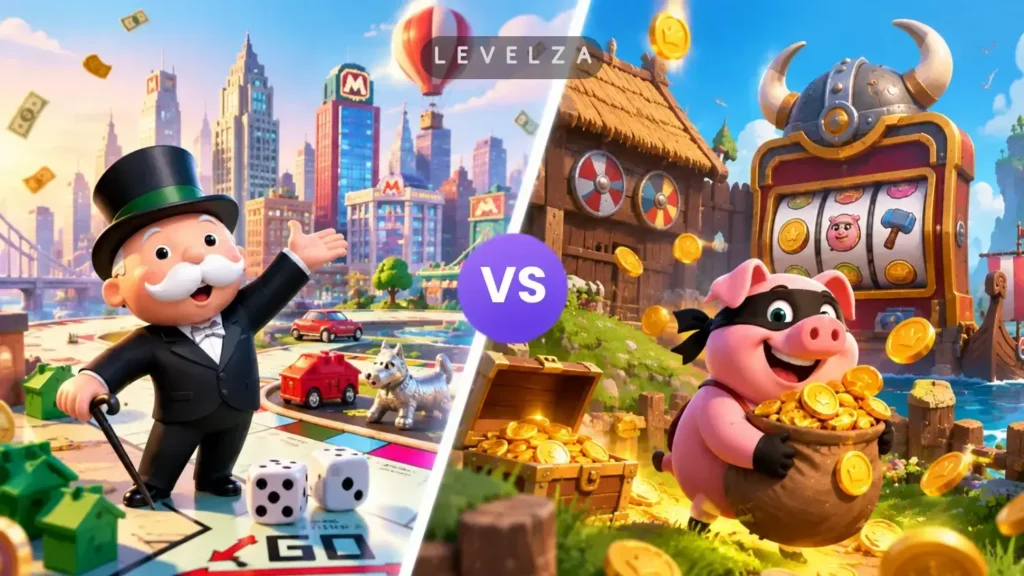


Monopoly GO vs Coin Master is one of the most common matchups players ask about, since both sit at the top of the social casual-raiding genre and share an unmistakable family resemblance. The surface-level assumption is that Monopoly GO is simply a “reskinned Coin Master” with a Hasbro coat of paint.
That assumption doesn’t hold up under closer architectural inspection. The two titles diverge sharply in roll mechanics, board spatiality, and how their collaborative live-ops systems actually function, and those differences matter far more than the shared raiding DNA suggests. Anyone weighing time between Monopoly GO and its slot-machine rival needs to look past the genre label first.
LEVELZA QUICK VERDICT
Neither title holds an absolute monopoly over the social casual-raiding genre, and the right pick depends heavily on how much tactical input a player actually wants. Monopoly GO grants meaningfully greater tactical control through board positioning and dice probability management, rewarding players who enjoy calculating risk before every roll.
Coin Master instead offers a frictionless, low-cognitive-load slot cycle built for pure impulse play, where spinning requires no spatial reasoning at all. Comparative testing shows both games converge on similarly steep free-to-play pacing walls despite this mechanical divergence.
Monopoly GO vs Coin Master: Head-to-Head Comparison Matrix
| Feature / Dimension | Monopoly GO | Coin Master | LEVELZA Analysis & Verdict |
|---|---|---|---|
| Core Movement & Input Engine | 40-tile closed board traversed via two six-sided dice (2d6 probability model). | 3-reel virtual slot machine with randomized symbol alignments. | Monopoly GO Wins. Navigating a tangible physical board introduces spatial awareness and calculable landing odds absent in raw slot reels. |
| Base Construction & Progression | 5 distinct landmarks per city with multi-tier upgrades and escalating costs. | Single village layout with 5 structures requiring sequential coin investment. | Tie / Situational. Both employ identical vertical sink models where base completion advances the next thematic map tier. |
| Social Raiding & Griefing Mechanics | Targetable Shutdowns against friend landmarks plus mini-game Bank Heists. | Single-target Village Attacks with hammer strikes and 3-hole vault Raids. | Monopoly GO Wins. Bank Heists introduce an interactive match-three tile mini-game rather than Coin Master’s automated coin digging. |
| Secondary Collection & Album Economy | Seasonal Sticker Albums featuring star-vault recycling and Golden Blitz trading windows. | Permanent thematic Card Sets with duplicate card trades and Pet leveling food. | Coin Master Wins. Coin Master’s pet system (Foxy/Tiger) adds permanent passive multipliers to raiding that sticker albums lack. |
| Collaborative Live-Ops & Events | Frequent co-op 4-player Partner Events and milestone tournament ladders. | Team Chests, solo spin tourneys, and card-sharing community requests. | Monopoly GO Wins. Co-op Partner events require real cooperative resource contribution, fostering deeper social engagement. |
| F2P Economy Pacing & Spin/Dice Decay | Passive regen of 5–8 dice/hr; high-cost landmark inflation creates hard pacing walls. | Passive regen of 5 spins/hr; spin caps and milestone requirements scale aggressively. | Tie / Situational. Both games hit steep free-to-play progression walls designed to push high-roller microtransactions. |
Core Mechanics Breakdown: Dice Strategy vs. Pure Slot RNG
Spatial Board Positioning vs. Slot-Reel Automation
Monopoly GO’s 2d6 movement gives players genuine mechanical agency that Coin Master’s slot reels simply don’t offer. A Monopoly GO player can calculate the 6-7-8 probability cluster before deploying a multiplier, weighing tile distance and dice pool risk before committing to a roll.
Coin Master players have no equivalent calculation available to them. Every spin is subject entirely to fixed-reel RNG weighting, and there’s no spatial layout to scout, no distance to measure, and no positional decision to make before pulling the lever.
That distinction changes what “skill” even means in each game. Monopoly GO rewards a player who studies the board ahead of a roll, while Coin Master rewards a player purely for having a large enough spin reserve to absorb variance.
Social Attack Asymmetry (Shutdowns vs. Hammer Strikes)
Player conflict looks superficially similar in both games but resolves very differently underneath. Monopoly GO’s shield system absorbs a fixed number of Shutdown attempts before a landmark takes real structural damage, and friends can specifically target undefended landmarks for a coordinated revenge attack.
Coin Master’s attack-blocking shields work on a comparable principle, but the addition of pet-assisted raids shifts the balance of power toward whichever player has invested more in permanent pet upgrades rather than toward tactical positioning. A well-leveled pet can meaningfully increase raid success independent of anything the attacking player does in the moment.
For casual offline accounts, Coin Master’s system is arguably the more punishing of the two, since pet-assisted raids compound in effectiveness over time regardless of how attentively a player defends, whereas Monopoly GO’s shield mechanic gives an offline player a hard, predictable buffer that scales only with how recently shields were topped off.
Platform Ecosystems, Cloud Sync & Desktop Accessibility
Mobile Client Performance
Monopoly GO’s high-fidelity 3D board animations create a visually richer experience than Coin Master’s simpler 2D sprite-based engine, but that visual polish comes at a comparative battery draw cost during extended sessions. Coin Master’s leaner rendering pipeline draws noticeably less power over an equivalent play session, making it the more battery-friendly option for marathon spinning.
Touch responsiveness is close to a wash between the two: both handle rapid-tap input reliably on modern hardware, though Monopoly GO’s richer animation layer can introduce a slight visual lag on older devices that Coin Master’s flatter presentation avoids entirely.
Desktop Accessibility
Neither title ships a native Steam or Microsoft Store client, which rules out a straightforward desktop install for either game. Monopoly GO instead supports Google Play Games on PC in beta, alongside standard Android virtualization for players outside that beta’s coverage.
Coin Master takes a different desktop route entirely, relying on Facebook Gaming’s web-browser bridge as its primary non-mobile access point, with Android emulation available as a secondary fallback. Players wanting the more officially supported desktop path currently have a slight edge with Monopoly GO’s beta program over Coin Master’s browser-dependent workaround.
Monetization Models: Microtransaction Velocity and F2P Ceilings
The Pacing Wall Comparison
Both titles restrict free progression through mechanisms that look different on the surface but function similarly underneath. Monopoly GO relies on landmark cost hyper-inflation, where each successive tile on a board costs a steep multiple of the last, quietly forcing dice purchases once natural regeneration falls behind construction demand.
Coin Master takes a parallel approach through escalating village upgrade prices layered with an aggressive spin-decay algorithm, where spin caps tighten relative to milestone requirements as a player’s village level climbs. Neither system is meaningfully more forgiving than the other by the time a player reaches mid-game content.
Aggressive Live-Ops Funnels
Startup pop-up cadence is comparably aggressive in both ecosystems, with limited-time flash sales queued before a session even begins in either app. Tournament milestone reward structures follow a similar escalating-cost pattern too, where early brackets pay generously and later brackets demand disproportionately more input for a comparatively smaller reward.
The practical difference shows up in how each game frames urgency: Monopoly GO leans on countdown timers tied to Partner Events and Solo Tournaments, while Coin Master leans more heavily on Viking Quest chapter deadlines and village-raid streak bonuses to create the same sunk-cost pressure.
TIP: Cross-Title Resource Hoarding Rule
Players running both games simultaneously should never split active sessions evenly across each title on the same day. Getting real value out of either economy requires full resource banking, holding dice or spins in reserve until a high-yield event goes live, whether that’s a Monopoly GO Partner Event or a Coin Master Viking Quest chapter, rather than spending steadily across both games without a target window in mind.