
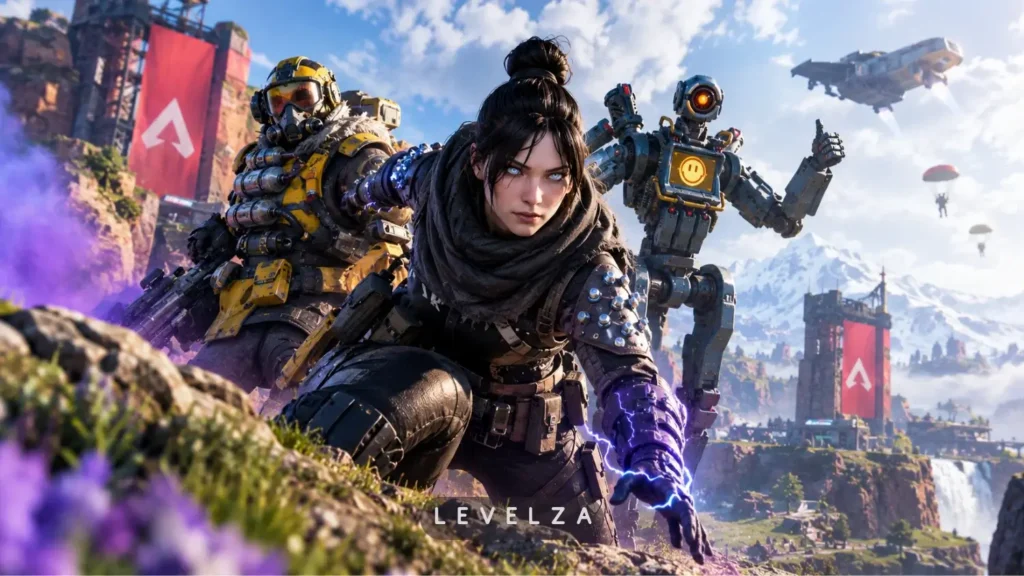
An apex legends review 2026 shows a battle royale that has outlasted many competitors by doubling down on mechanical complexity. While rivals have shifted toward broader, more casual formats, Respawn Entertainment’s hero shooter remains a high-tempo tactical arena where movement mastery and sustained gun tracking separate champions from early lobby drops.
Years of continuous live-service layering have also created friction: inconsistent audio cues in crowded fights, visual clutter from ultimate abilities, and cosmetic collection event pricing that tests even dedicated veterans.
Gameplay and Legend Evolution: Apex Legends Review 2026
The core of Apex Legends is its combat physics, and these remain the reason it holds its audience. Three systems define the current experience: movement, armor progression and squad composition.
Kinetic Movement and Gunplay Physics: Unmatched Fluidity
The heavily modified Source engine preserves momentum across state changes. Speed built by sprinting or by sliding down a slope carries into a jump and then into air movement, so slide-jumps, wall-bounces and zipline exits become connected tools rather than isolated actions. That flexibility sets the game apart from shooters where traversal means moving between pieces of cover.
The gunplay complements the movement. Time-to-kill is comparatively high, recoil demands active compensation, and weapons reward continuous tracking accuracy over instantaneous flick shots. A fight therefore lasts long enough for movement, ability use and positioning to matter, and a player who tracks smoothly through a slide-jump gains a real advantage.
The EVO Armor Overhaul and In-Match Perk Trees
Evo armor changed how a match develops. Shields start at a low tier and level up through colored tiers toward Red as the player deals damage and completes team-oriented map interactions. Armor strength therefore depends far less on loot luck in the opening minutes than it did under a pure pickup model.
The mid-match upgrade choices for Legends build on the same idea. Selecting a tactical upgrade personalizes a Legend’s toolkit, and it adds strategic adaptability to late-game circles. The trade-off is added decision load in a game that already demands attention to movement and positioning.
Squad Synergy and the Five Legend Classes
Legends fall into five classes: Assault, Skirmisher, Recon, Controller and Support. The class sets a squad role, while each Legend adds a passive, a cooldown-driven tactical ability and an ultimate. Class-level utility, such as Recon Legends scanning survey beacons to reveal the next ring, rewards deliberate team composition over a random collection of favorites.
The Ping system backs this structure with non-verbal coordination. Ranked play still rewards coordinated squads, and solo-queue players matched with uncommunicative teammates can find the experience frustrating.
Technical Performance, Engine Architecture, and Hardware Scalability
Desktop Performance and the Limits of Modified Source
The engine delivers high competitive frame rates on modest PC hardware, which is a genuine strength for a free-to-play title. The remaining issues are familiar ones. Shader compilation can cause stutter after patches, large smoke and thermite effects can create processor bottlenecks in crowded fights, and the experimental DirectX 12 renderer is less reliable than the long-standing Direct3D 11 path on many systems.
Audio is the most persistent complaint. The Miles Sound System does not always prioritize close-range enemy footsteps over ambient gunfire or announcer lines during chaotic multi-squad engagements, and footstep cues are the most useful information in a close fight. Stereo output generally preserves left-right positioning better than virtualized surround in this game.
Current-Gen Consoles vs. Nintendo Switch Compromises
PlayStation 5 and Xbox Series X|S offer a Performance Mode toggle that delivers 120 Hz output on compatible displays. Higher refresh rates reduce input latency and make tracking moving targets noticeably smoother, which brings console play close to competitive parity.
The Nintendo Switch version makes heavy compromises. Visual fidelity and the frame-rate ceiling sit well below the PC and current-generation console clients, which makes it a convenient portable option but a poor fit for competitive play.
Monetization Ethics and Long-Term Live-Service Value
Competitive free-to-play purity. The core game remains skill-based. Legends can be acquired using Legend Tokens earned in play, and no purchasable item provides a statistical combat advantage.
Battle Pass sustainability. Seasonal Battle Pass value depends on how much progression an active player earns relative to the cost of the pass, and the details change between seasons. The storefront listing is the reference for current terms.
The mythic economy critique. High-tier Collection Events, heirlooms and prestige skin recolors cater heavily to high-spending collectors. Casual participants see diminishing returns on these items, which is the sharpest criticism of the commercial model.
Operational Setup Advisory
LEVELZA Onboarding and Sensitivity Advisory
New players should resist the urge to play with high mouse or controller sensitivity. The game’s higher time-to-kill rewards extended tracking accuracy over rapid flick shots, so lower sensitivity makes it easier to follow moving targets through slide-jumps. PC players should also apply verified Apex Legends best PC settings to reduce visual clutter and stabilize frame pacing before queueing into ranked.
Who Should Play Apex Legends in 2026 (And Who Should Skip It)
You Will Love Apex Legends If:
- You want mechanical depth and a shooter that rewards dedication to movement technique, slide-jumping and recoil compensation.
- You enjoy fast-paced, coordinated three-player firefights where character abilities complement pure gunplay.
- You value a higher time-to-kill that leaves tactical room to reset, swap armor and outplay opponents mid-fight.
You Should Skip Apex Legends If:
- You prefer low-stress military shooters with instant, low time-to-kill ambushes.
- You play exclusively solo without a microphone and are easily frustrated by uncoordinated team matchmaking.
- You demand flawless spatial footstep audio, or you plan to play on handheld hardware such as the Nintendo Switch.