

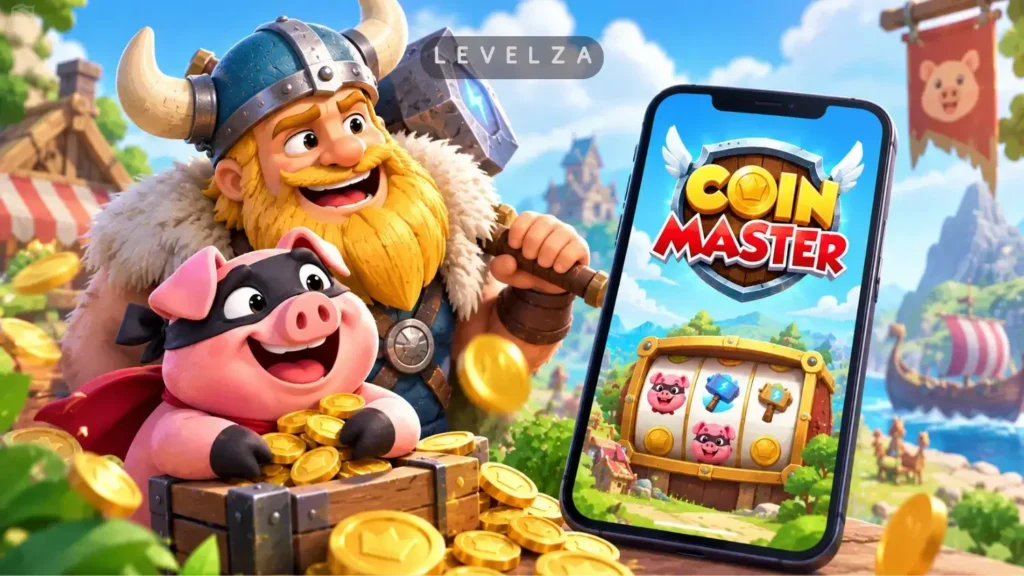
This Coin Master review confronts the central contradiction defining Moon Active’s title in 2026: the game continues generating staggering mobile revenue even as player communities push back hard against hyper-inflated village construction costs, simulated-gambling design loops, and punishing offline base destruction.
Most coverage online either dismisses the game as mindless casino fluff or praises it purely on the strength of its celebrity marketing campaigns. LEVELZA’s evaluation instead investigates technical stability, pet companion mathematics, and free-to-play sustainability across long-term village cycles on Coin Master.
QUICK VERDICT
The core slot loop delivers instant, low-cognitive-load tactile satisfaction that explains much of the game’s staying power. Extreme mid-game coin inflation and an aggressive hourly spin limit severely penalize non-paying players who fail to practice strict resource banking, turning what starts as a relaxed pastime into a disciplined grind by the mid-game.
Comprehensive Coin Master Review: Slot Loop & Progression
The 3-Reel Slot Engine & Variable Bet Psychology
Every meaningful action traces back to the virtual slot machine, and the Bet multiplier mechanic sits at the center of its psychological pull. Scaling a bet from 1x up through the Super Bet tier doesn’t change the odds of any given symbol landing, but it does scale the payout, which creates constant pressure to bet higher than a session actually calls for.
That pressure is precisely what encourages players to liquidate an entire spin bank in under 60 seconds while chasing a favorable raid payout. The mechanic is engineered around exactly the kind of escalating-stakes impulse that makes stopping at a reasonable point genuinely difficult.
Village Cost Escalation & Asynchronous Raiding
The base-building loop asks for 25 individual star upgrades spread across 5 structures per village, and the cost curve behind those upgrades is anything but linear. Early villages clear on a modest coin budget, but late-game villages can demand a single building cost running into the billions of coins.
That steep curve leaves players in a genuinely precarious position, since any coin balance sitting idle overnight is vulnerable to a friend’s hammer attack the moment a structure is left half-built. The asynchronous raiding system turns what could be a purely solitary building game into something considerably more tense.
Card Sets, Golden Trades & Companion Pets
Collectible card albums function as one of the game’s most important long-term retention hooks, since completing a full set provides a multi-thousand spin injection substantial enough to meaningfully reset a stalled progression curve. That payout structure gives the collection loop real strategic weight rather than serving as pure cosmetic flavor.
Companion pets add a second, more permanent layer on top of card collection. Foxy, Tiger, and Rhino each introduce their own percentage multiplier that shifts competitive raiding odds in a lasting way, meaning two accounts at the same village level can perform very differently in practice depending on how well their pets have been leveled.
Technical Performance, Battery Overhead & Network Resilience
Mobile Performance (iOS/Android)
The 2D sprite engine underpinning Coin Master carries a comparatively light rendering footprint, which translates directly into smoother frame rates and lower battery draw than most modern 3D competitors in the same genre. That efficiency holds up well even on older hardware that would struggle with a heavier 3D pipeline.
Touch responsiveness during fast-spin sequences stays reliable throughout, with no noticeable input lag even when a player is rapid-tapping through consecutive spins during a tournament push.
Desktop Accessibility (Facebook Gaming vs. Emulation)
The Facebook Gaming web bridge offers the most frictionless non-mobile access point available, requiring zero installation to get into a session. That convenience comes with a real trade-off: the browser bridge suffers from frequent session token disconnects during prolonged idle periods, forcing a fresh login more often than a dedicated client would.
Android virtualization through BlueStacks or GameLoop handles idle sessions more gracefully than the browser bridge, at the cost of a heavier initial setup process.
Network Resilience
The client-server handshake underlying every spin is noticeably sensitive to connection quality during high-multiplier bets specifically. Minor network packet drops during a coin toss or a raid transition can trigger the widely reported “Connection to server lost” modal, cutting off a session at exactly the moment a big payout was resolving.
Target Audience Analysis: Who It’s For vs. Who Should Skip It
Coin Master suits casual mobile users looking for low-commitment sessions that rarely run longer than three minutes at a time. It also fits players who genuinely enjoy the social side of card collection communities, along with anyone who thrives on the competitive tension of asynchronous revenge raiding against friends.
It is a poor fit for players who are susceptible to gambling-adjacent behavioral loops, given how closely the slot mechanics mirror commercial casino design. Purists seeking real tactical strategy or deep world-building should look elsewhere, and non-paying players unwilling to manage strict coin-hoarding routines will find the late-game pacing considerably more punishing than the early villages suggest.
Anyone planning to invest seriously in companion pets should read LEVELZA’s Coin Master pet guide before committing XP potions, since misallocating them early is one of the most common regrets reported by longtime players.
WARNING: The In-App Purchase Spin Liquidation Trap
Purchasing mid-tier spin packages rarely results in permanent progression. Spun at elevated multipliers such as 3x or 5x, a purchased pack of several hundred spins can vanish in under two minutes without guaranteeing a village level completion or the completion of a rare card set.
Monetization Models, Simulated Gambling & F2P Longevity
The Free-to-Play Bottleneck
The passive recharge limit of 5 spins per hour looks reasonable in isolation, but it collapses mathematically against late-game village construction costs. Once a player reaches the tier where a single building costs a coin sum far beyond what passive trickle income can supply in any reasonable timeframe, uncoordinated free-to-play progression hits a genuine standstill.
Escaping that standstill without spending real money requires active card trading and disciplined event completion rather than simply waiting for spins to accumulate.
Simulated Gambling Psychology & Pop-Up Queues
Startup consistently greets players with a cascade of promotional pop-up offers before a session even begins, layered with limited-time flash sales and event countdown timers designed to manufacture urgency. That cascade leans directly on sunk-cost psychology, since each subsequent offer is framed as building on whatever was purchased just before it.
The reel mechanics themselves borrow directly from commercial casino design language, including near-miss visual animations that are well documented in gambling research as a driver of continued play regardless of actual outcome.