

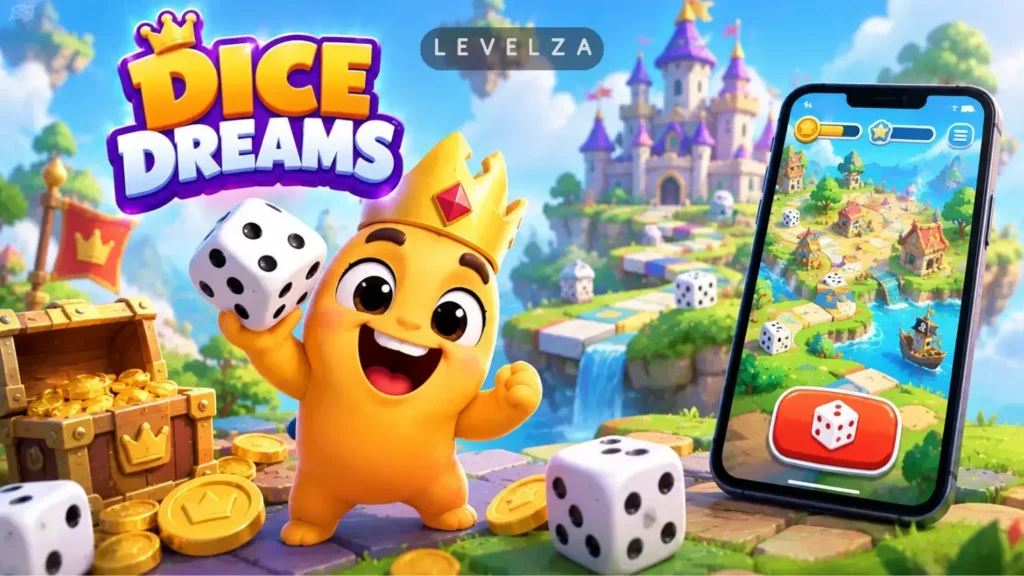
This Dice Dreams review confronts the defining tension surrounding SuperPlay’s title in 2026: its colorful, charming visual presentation and tactile physics loop stand against mounting player frustration over aggressive milestone paywalls, punitive offline kingdom raiding, and steep late-game building costs.
Most coverage evaluates the game purely on its animated cartoon aesthetic while ignoring the underlying social casino mechanics driving the loop underneath. LEVELZA’s evaluation instead investigates technical stability, 3-dice probability math, and free-to-play sustainability across long-term kingdom cycles on Dice Dreams.
QUICK VERDICT
The physical 3-dice rolling engine and manual slingshot aiming provide genuine tactile satisfaction that feels superior to traditional slot machines. Late-game kingdom cost inflation and a restrictive passive roll regeneration rate severely punish uncoordinated free-to-play players, turning what starts as charming casual play into a disciplined grind by the mid-game.
Comprehensive Dice Dreams Review: Rolling Loop & Progression
The 3-Dice Physics Engine & Multiplier Psychology
SuperPlay’s physical tray simulation, where three dice tumble with genuine momentum and friction, sets Dice Dreams apart from flat digital RNG systems found in most competitors. That tactile bounce is a meaningful part of the appeal, giving each roll a sense of physical consequence a simple instant resolution lacks.
The Bet multiplier mechanic sits at the center of the game’s psychological pull, scaling from 1x up to a Super Bet tier. That scaling encourages players to liquidate an entire banked roll pool in under two minutes while chasing a triple Free Roll combo, since the payout math rewards higher bets disproportionately during a lucky streak.
Kingdom Architecture, Peon Dynamics & Slingshot Attacks
The base-building loop spans more than 150 kingdoms, each requiring a multi-tier upgrade model for its landmark structures. Animated citizen Peons add genuine charm to that construction process, cheering during upgrades and visibly reacting to the state of their surroundings.
The manual slingshot raiding mechanic is where the game’s tactile identity shows most clearly, requiring players to physically aim at enemy towers to bypass active shields. That aiming step introduces a real skill component that automated raiding systems in competing titles simply don’t offer.
Thematic Sticker Albums & Live-Ops Trail Quests
Completing collectible sticker sets provides an essential multi-thousand roll injection large enough to meaningfully reset a stalled kingdom, giving the collection loop genuine strategic weight beyond pure cosmetic appeal. That payout structure makes tracking incomplete sets a real part of long-term planning rather than an optional side activity.
Time-limited live-ops events, such as Peon Rush and Trail Quests, demand aggressive roll expenditure on a tight schedule. Both formats reward disciplined pre-event banking far more than casual, unplanned spending throughout the week.
Technical Performance, Battery Overhead & Network Resilience
Mobile Performance (iOS/Android)
The 3D graphics pipeline delivers fluid character animations and responsive touch feedback that hold up well during normal play. That visual quality comes at a real cost, though, since heavy battery drain and noticeable thermal throttling set in during prolonged rolling sessions on mid-range handsets.
Players running extended sessions on older or budget devices should expect meaningfully faster battery depletion than a comparable session on a lighter 2D title would produce.
Desktop Accessibility (Emulation)
Android emulators such as BlueStacks, GameLoop, and LDPlayer offer a genuine tactile advantage for slingshot aiming, since mouse precision outperforms a touchscreen swipe for that specific mechanic. That advantage comes with real setup friction attached.
Emulator play requires manual keybinding configuration, and startup memory allocation crashes are a documented risk if virtualization settings, particularly RAM and CPU core allocation, are misconfigured going in.
Network Resilience & The “Polishing Dice” Freeze
The client-server handshake underlying every roll is noticeably sensitive to connection quality. Minor packet loss during roll resolution or asset streaming can trigger the infamous “Polishing Dice” startup freeze, alongside the related Mountain-00016 disconnect error that interrupts an active session mid-play.
Target Audience Analysis: Who It’s For vs. Who Should Skip It
Dice Dreams suits casual mobile gamers who appreciate tactile, physics-driven gameplay over automated slot reels, along with players who genuinely enjoy manual aiming mini-games as part of their raiding strategy. Fans of charming, expressive animated character aesthetics will also find a lot to like in the Peon-populated kingdoms.
It is a poor fit for players susceptible to gambling-adjacent behavioral loops, given how closely the bet-scaling mechanics mirror commercial casino design. Tabletop purists seeking deep property strategy or genuine trading negotiation should look elsewhere, and free-to-play players unwilling to practice strict roll-hoarding routines will find the late-game pacing considerably more punishing than the early kingdoms suggest.
Anyone planning to push seriously into tournament brackets should read LEVELZA’s Dice Dreams rolls strategy guide before committing a banked roll pool, since misjudging multiplier timing is one of the most common regrets reported by longtime players.
WARNING: The In-App Purchase Roll Liquidation Trap
Purchasing mid-tier dice packages rarely results in permanent progression. Spun at elevated multipliers such as 3x or 5x, a purchased pack of several hundred rolls can vanish in under two minutes without guaranteeing a kingdom level completion or securing a top tournament milestone rank.
Monetization Models, Simulated Gambling & F2P Longevity
The Free-to-Play Bottleneck
The passive recharge rate of 5 rolls per hour looks reasonable in isolation, but it collapses mathematically against late-game kingdom construction costs. Once a kingdom reaches the tier where remaining upgrades demand a coin sum far beyond what trickle income can supply in any reasonable timeframe, uncoordinated free-to-play progression stalls completely.
Escaping that stall requires disciplined roll banking and active event synchronization rather than simply waiting for the passive rate to accumulate enough on its own.
Simulated Gambling Psychology & Pop-Up Queues
Startup consistently greets players with a cascade of promotional pop-up bundles before a session even begins, layered with limited-time flash sales and event countdown timers engineered to manufacture urgency. That cascade leans directly on sunk-cost psychology, framing each subsequent offer as building on whatever was purchased just before it.
The rolling mechanics themselves borrow familiar casino design language too, including near-miss visual animations that create the perception of an almost-successful outcome regardless of what the dice actually landed on.