

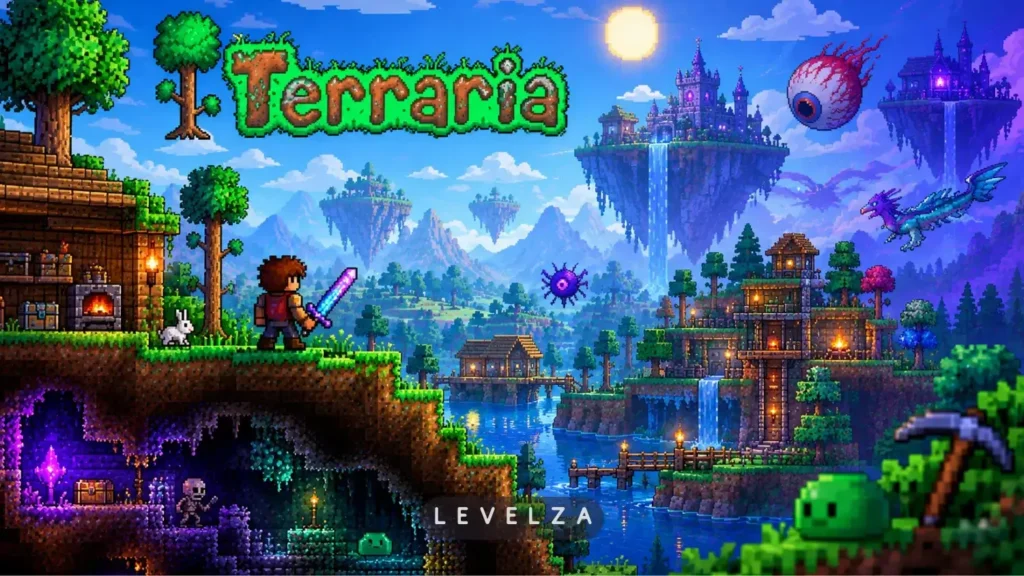
In this definitive Terraria review, LEVELZA evaluates whether Re-Logic’s seminal 2D action-sandbox remains a pinnacle of mechanical game design, or whether its aging engine architecture and punishing progression curve struggle to hold up in modern gaming.
Mainstream outlets historically dismissed Terraria as a “2D Minecraft clone,” overlooking its actual identity as a hardcore, gear-driven action-RPG. LEVELZA instead evaluates high-speed combat hitboxes, four-class itemization depth, boss choreography, and platform parity across the full Terraria ecosystem.
QUICK VERDICT
- Overall Critical Verdict: Essential / Masterpiece. An unrivaled benchmark of 2D action-adventure design that marries boundless creative sandbox freedom with the depth, speed, and boss complexity of a top-tier action-RPG.
- Greatest Strength: Exhilarating boss encounter design paired with deep four-class gear itemization and thousands of synergistic weapons and accessories.
- Greatest Flaw: Opaque initial progression and crafting discovery that practically mandates consulting an external wiki, alongside cluttered touch controls on mobile devices.
Terraria Review: Combat Depth and Boss Progression
The 4-Class Archetypes and Gear Synergy
The class ecosystem sits at the center of everything Terraria does well. Melee, Ranged, Magic, and Summoner builds each carry their own dedicated weapon types, and armor set bonuses reinforce that specialization rather than treating classes as cosmetic labels.
Each class also runs on a genuinely distinct resource mechanic rather than a shared universal system. Mages consume mana with every cast, and pushing mana too low or spamming certain high-cost spells can trigger Mana Sickness, a debuff that temporarily reduces maximum mana as a direct penalty for reckless casting.
Rangers instead manage ammo consumption, where specialized bullet types like Chlorophyte, Ichor, or Crystal rounds add homing behavior, defense-reducing effects, or bonus damage respectively, while certain armor sets grant a chance to avoid consuming ammo entirely on a given shot. Summoners work around minion slot stacking, where each equipped accessory or armor piece raising the minion cap allows more simultaneous summons, and whip-type weapons apply a tag-damage bonus that boosts the summoned minions’ own damage output rather than dealing much direct damage themselves.
Five to seven accessory slots layer on top of all three systems, and accessory reforging through the Goblin Tinkerer lets players fine-tune a build around pure damage, critical chance, or defense — a Warding modifier adding flat defense being one of many concrete examples. The result is a genuinely deep itemization system rather than a simple gear ladder.
Boss Choreography and the Hardmode Catalyst
Early bosses like the Eye of Cthulhu and Skeletron function as teaching tools, introducing positioning and dodge timing at a manageable pace before the difficulty escalates.
Defeating the Wall of Flesh triggers Hardmode, and the world evolves at that exact moment into a far more intense, high-speed bullet-hell experience. Late-game encounters — Plantera, the Empress of Light, the Moon Lord — demand dedicated arena construction, wings, dash accessories, and genuinely precise aerial dodging rather than simple positioning.
That jump in intensity is one of the more dramatic mid-game shifts in any sandbox title, and it’s arguably the single strongest argument for the game’s design.
Performance, Cross-Platform Controls & Mobile Adaptations
PC Precision vs. Console & Mobile Adaptation: The PC version provides pinpoint cursor aiming for grappling hooks and mining that the game was clearly designed around first. Re-Logic and 505 Games have implemented customizable dual-stick touch controls on mobile, which is a genuine effort at parity.
Screen clutter and finger occlusion during chaotic late-game boss fights remain a real, tangible handicap on mobile compared to mouse-and-keyboard or a physical gamepad, though — this isn’t a fully solved problem, just a meaningfully mitigated one.
Engine Efficiency and Hardware Scaling: The 2D engine’s lightweight nature is one of Terraria’s quieter strengths. It runs at a locked 60 FPS on nearly any modern consumer hardware, drawing minimal battery on mobile devices and running without issue on handhelds like the Steam Deck.
Two under-discussed settings directly affect that performance on lower-tier hardware. The frame-skip setting, toggled between Subtle, On, and Off, controls how aggressively the engine drops rendered frames to preserve simulation speed during heavy load — Subtle is the best default for most systems, since a fully Off setting can visibly stutter during dense particle-effect boss phases on weaker CPUs.
Lighting engine mode has a similar impact. Color mode is the visually richest but most demanding option, White mode strips colored lighting for a flatter but cheaper render, Retro mode reverts to the original low-fidelity lighting system entirely, and Trippy mode is a cosmetic novelty option — switching down from Color to White or Retro measurably reduces draw calls on integrated graphics or older laptops struggling to hold 60 FPS during crowded fights.
Who It’s For / Who Should Skip It
Who It’s For:
- Action-RPG enthusiasts who crave intense, high-stakes boss encounters that demand arena preparation, dodging reflexes, and gear optimization.
- Loot hoarders and theory-crafters who love experimenting with accessory reforging, armor set bonuses, and distinct weapon classes.
- Players seeking tremendous single-player or cooperative multiplayer depth with thousands of items and zero microtransactions.
Who Should Skip It:
- Gamers looking purely for a relaxing, low-stakes building simulator with minimal combat pressure.
- Players who dislike consulting external wikis or reading item tooltips to decipher progression milestones.
- Those who experience motion sickness or visual fatigue from dense, screen-filling 2D projectile patterns.
Ready to brave a first subterranean expedition? Follow the step-by-step guide on How to Play Terraria to master starter crafting grids, build valid NPC housing, and survive the first night safely.
TIP — OVERCOMING THE EARLY-GAME INFORMATION WALL WITHOUT SPOILERS
Show the in-game Guide NPC any item marked as a “Material” to view its complete crafting recipes and required crafting stations.
This single habit minimizes the need to tab out to external wikis during the opening hours of a playthrough, when the crafting tree is at its most opaque.
Monetization, Modding Ecosystem & Value Assessment
The Gold Standard of Developer Stewardship: Re-Logic’s update history stands out even by the standards of long-supported games. Over a decade of massive free content expansions — spanning 1.1, 1.2, 1.3, 1.4 Journey’s End, and Labor of Love — have arrived without a single paid DLC pack or microtransaction attached.
Steam tModLoader Integration: tModLoader is an officially sanctioned, standalone 64-bit application distributed directly on Steam, not a third-party workaround. That 64-bit transition onto .NET is a technical milestone that’s easy to undervalue: the legacy 32-bit build was capped by a roughly 4 GB virtual memory ceiling, which is precisely why massive total conversion mods like Calamity or Thorium once risked out-of-memory heap crashes when loaded together with several other large mods.
Removing that ceiling through the 64-bit runtime is what actually makes today’s largest total conversions stable at all, allowing them to effectively double the game’s content on top of vanilla — new classes, hundreds of additional bosses, and entirely new crafting trees — for thousands of hours of post-vanilla replayability that the older architecture simply couldn’t have supported reliably.