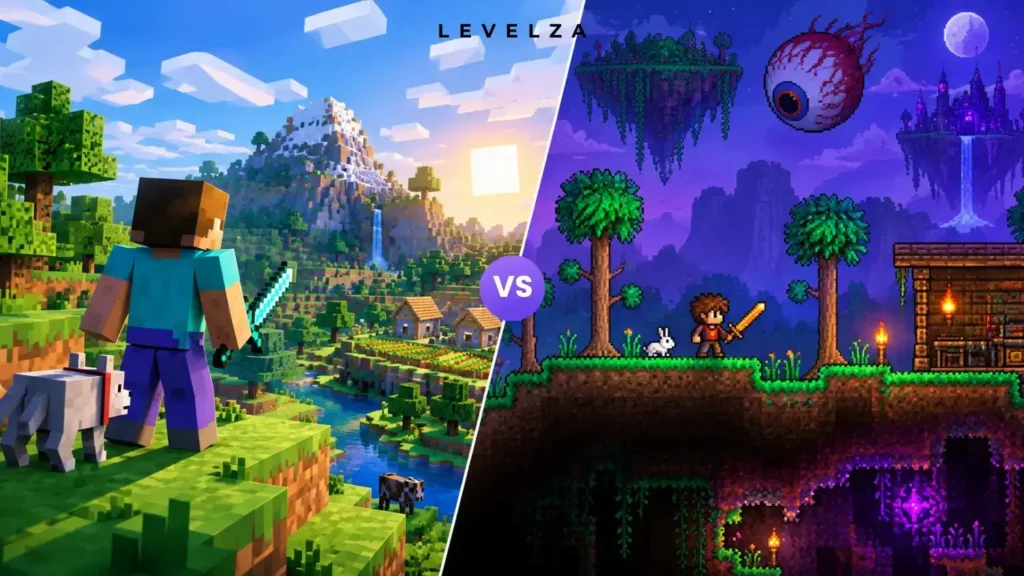


Pitting Minecraft vs Terraria as simple 3D versus 2D versions of the same game fundamentally misreads what each engine actually prioritizes. Both titles drop players into procedurally generated worlds with a mining pick in hand, but their gameplay loops diverge completely from there.
One is an expansive, architectural survival sandbox. The other is a dense, combat-driven action-RPG disguised as a side-scrolling builder. Surface comparisons tend to stop at visual perspective and basic tool progression, but LEVELZA comparative analysis evaluates the structural realities that actually define both games: combat hit-boxes, boss choreography, itemization curves, engineering logic systems, and long-term world permanence, grounded in the foundational Minecraft platform architecture.
QUICK VERDICT
- Verdict Summary: Situational / It’s a tie. The choice depends entirely on whether the priority is spatial immersion, infinite 3D construction, and freeform engineering, or intense action-RPG boss fights, deep equipment class builds, and structured progression milestones.
- Core Strength of Minecraft: Absolute 3D architectural freedom, unparalleled atmospheric exploration, and Turing-complete redstone automation.
- Core Strength of Terraria: Masterful combat encounter design, 15-plus layered boss encounters, thousands of unique weapons and accessories, and a radical mid-game world transformation known as Hardmode.
Minecraft vs Terraria: Head-to-Head Comparison Matrix
| Feature / Dimension | Minecraft | Terraria | LEVELZA Analysis & Verdict |
|---|---|---|---|
| Perspective & Structural Building | First/third-person 3D voxel world with 360-degree spatial building freedom. | 2D side-scrolling pixel cross-section with tile-based grid placement. | Minecraft Wins: Full 3D spatial geometry enables genuine architectural depth, interior room scale, and terrain sculpting that a 2D plane simply cannot match. |
| Combat Mechanics & Boss Encounter Design | Basic melee and ranged combat with shields and simple sweep attacks; two major bosses (Ender Dragon, Wither). | High-speed, mobility-driven, class-based combat with 15+ progression-gated bosses featuring multi-stage bullet-hell attack patterns. | Terraria Wins: Incomparably deeper combat, weapon diversity, mobility accessories, and boss encounter design. |
| Loot System & Equipment Progression | Linear material progression from Wood to Netherite, with basic enchantments and limited armor slots. | Deep multi-tier crafting trees with thousands of weapons, armor sets, and 5–7 equippable accessory slots providing unique perks. | Terraria Wins: A vastly richer item economy, where accessory tinkering and distinct character classes dictate playstyle. |
| Logic Systems & Automation Engineering | Turing-complete redstone system allowing physical item sorting, wireless signals, and computational logic. | Wire-and-wrench mechanical system for dart traps, teleporters, boulder drops, and basic timers. | Minecraft Wins: Redstone offers an unmatched, physically simulated engineering pipeline capable of massive automated industrial farms and functioning computers. |
| World Generation & Exploration Pacing | Mathematically infinite procedural terrain with diverse biomes, caves, and three distinct dimensions. | Fixed-size bounded worlds (Small, Medium, Large) featuring densely layered subterranean vertical biomes. | Tie / Situational: Minecraft delivers limitless, relaxing 3D wilderness exploration; Terraria delivers dense, danger-packed underground vertical dungeon-crawling. |
| Modding Ecosystem & Official Integration | Massive open-source community frameworks on Java (Fabric, Forge, NeoForge) with manual launcher profile management. | A dedicated, officially Steam-integrated mod loader (tModLoader) with 64-bit architecture and one-click workshop installs. | Tie / Situational: Minecraft Java offers world-altering total conversion mods; Terraria offers seamless, officially sanctioned mod integration through Steam. |
Architectural Engine & Spatial Perspective Differences
3D Voxel Horizons vs. 2D Layered Subterranean Density
Minecraft uses an infinite chunk-loading matrix that renders terrain outward in a full 360-degree radius around the player, with no fixed edge to the explorable world. Terraria takes the opposite trade-off, using a bounded world container that sacrifices infinite horizontal scale for extraordinary vertical density.
Within that bounded space, Terraria packs traps, unique ores, treasure rooms, and distinct vertical layers — Space, Surface, Underground, Caverns, and the Underworld — into a single continuous cross-section that a purely 3D game has no direct equivalent for.
Building Mechanics: Architectural Scale vs. Dollhouse Detailing
Minecraft lets players walk inside the structures they build, experience natural lighting gradients through windows, and design genuinely three-dimensional estates with real interior scale. It’s architecture in the literal sense of the word.
Terraria’s building paradigm works more like an intricate, decorative ant farm. Visual appeal there depends on micro-detailing — wall paint, furniture placement, specific NPC housing requirements, and layered background blocks — rather than on walkable three-dimensional space.
Core Mechanics & Feature Differences
Linear Survival Tools vs. Four-Class RPG Builds
Minecraft maintains a utilitarian, linear gear ladder running from Wood through Stone, Iron, Diamond, and Netherite, where gear exists primarily to enable survival and resource gathering rather than to define a playstyle.
Terraria instead builds around deep class specialization: Melee, Ranged, Magic, and Summoner builds, each supported by accessory forging, armor set bonuses, and reforging modifiers such as Warding, Menacing, or Legendary. A Terraria loadout is a build in the RPG sense; a Minecraft loadout is closer to a toolkit.
Encounter Design: Survival Defense vs. Bullet-Hell Boss Arenas
Minecraft’s Ender Dragon is fundamentally an environmental arena encounter, manageable with arrows and well-placed water buckets. Terraria’s bosses ask for something structurally different: dedicated multi-tiered sky bridges, campfire and heart-lantern buff stations, and high-speed mobility items like wings, dash shields, and grappling hooks to dodge complex bullet-hell attack waves from bosses such as the Wall of Flesh, Plantera, and the Moon Lord.
Platform Availability & Cross-Progression
Terraria runs on a lightweight, optimized 2D C# runtime capable of sustaining a locked frame rate on nearly any low-power consumer laptop or mobile device. Minecraft’s JVM-based Java Edition carries meaningfully heavier memory requirements by comparison, often benefiting from performance mods like Sodium or Iris to sustain long render distances on the same class of hardware.
Modding accessibility follows a similar split. Terraria’s tModLoader is distributed directly as a free application on Steam with integrated workshop browsing built in. Minecraft Java’s mod ecosystem is decentralized by comparison, relying on external loaders like Fabric or NeoForge and typically requiring a third-party launcher such as Prism, CurseForge, or Modrinth to manage dependency trees and Java versions.
World evolution also diverges sharply between the two. Minecraft’s world rules stay static from the first day to the endgame. Terraria, by contrast, permanently transforms after defeating the mid-game Wall of Flesh boss, triggering Hardmode — a world-altering event that generates the Hallow, accelerates Corruption or Crimson spread, changes enemy spawns, and introduces an entirely new tier of materials and threats.
Pricing & Licensing Comparison
Both titles ship as one-time purchases rather than subscription products, though their engineering overhead differs sharply enough to matter for lower-end hardware. Terraria’s 2D engine imposes a comparatively light system footprint, making it the more forgiving choice on budget or older devices. Minecraft’s 3D voxel simulation, particularly on Java Edition with mods installed, asks for meaningfully more dedicated RAM and CPU headroom to sustain the same level of smooth performance.
Neither game gates core content behind a subscription or recurring purchase; expansion in both cases comes from free updates rather than paid downloadable content, keeping the long-term cost of ownership low for both titles.
TIP — MANAGING MULTIPLAYER INFRASTRUCTURE AND WORLD PORTABILITY
Minecraft worlds are tied to specific game versions and mod configurations, so sustaining 24/7 access for a group typically requires a cloud Realms subscription or third-party server hosting rather than simply leaving a local world running.
Terraria decouples characters from worlds entirely — a player’s personal inventory, weapons, and accessories carry across multiple single-player and multiplayer worlds without any loss of gear, which makes jumping between different friend groups’ worlds far more frictionless.