

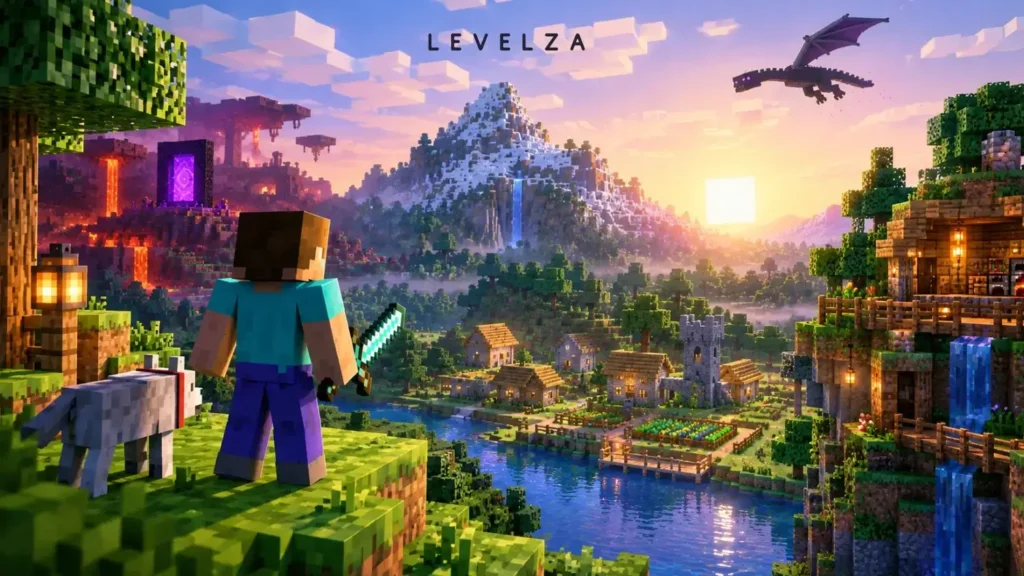
In this definitive Minecraft review, LEVELZA examines whether the best-selling standalone video game in history retains its creative dominance, or whether technical engine fragmentation and feature bloat have diluted its core sandbox purity.
Mainstream outlets tend to review Minecraft through a nostalgic lens or shallow patch-note summaries, glossing over critical technical realities like the Java-versus-Bedrock divide, unoptimized vanilla JVM rendering pipelines, and the shifting economics of the Bedrock Marketplace. LEVELZA instead evaluates cross-platform performance, survival progression pacing, and developer stewardship across the full Minecraft ecosystem.
QUICK VERDICT
- Overall Critical Verdict: Essential / Universally Recommended. An unmatched, foundational creative work that offers infinite replayability, provided players navigate its bifurcated engine ecosystem and make use of community optimization tools.
- Greatest Strength: Limitless 3D spatial building freedom, profound atmospheric procedural exploration, and an unmonetized open-source Java modding community that ensures perpetual relevance.
- Greatest Flaw: Ongoing technical fragmentation between Java Edition and Bedrock Edition, compounded by sluggish unmodded vanilla Java performance on modern multi-core processors.
Minecraft Review: Gameplay Depth and World Generation
The Evolution of Procedural Terrain: Scale vs. Traversability
Minecraft’s modern terrain generation has genuinely transformed the game’s atmosphere. Expanded vertical world limits — running from -64 up to 320 — combined with sprawling cave and aquifer systems have produced a level of geological realism that early versions of the game never approached.
That expanded scale carries a practical cost, though. Navigating mountainous biomes early in a playthrough, before acquiring an Elytra or any real mount option, can feel genuinely tedious. The vertical richness that makes exploration visually striking is the same trait that slows basic traversal down in the early game.
The Survival Gameplay Loop and Endgame Motivation
The progression arc splits cleanly into two very different halves. Early-game tension — hunting for food, securing shelter before nightfall, locating the first iron deposits — is tightly paced and consistently engaging.
Late-game structure is a different story. Defeating the Ender Dragon effectively marks the end of any scripted progression path, after which players are left entirely reliant on intrinsic motivation: self-directed mega-projects, automated redstone farming, or simply exploring further for its own sake. This isn’t necessarily a flaw, but it is a real design choice that some players adjust to more easily than others.
Mojang’s recent structural content has visibly aimed at that exact gap. The Trial Chambers structure introduced in the Tricky Trials update gives mid-to-late-game players a repeatable, combat-focused dungeon loop with escalating difficulty, rather than relying purely on open-ended self-direction.
Ominous Vaults tied to that same structure reward players with gear otherwise unavailable through normal crafting, while the Mace weapon introduces a high-risk melee playstyle built around fall-damage-amplified strikes. These additions don’t replace the need for self-directed goals late in a playthrough, but they meaningfully soften the drop-off in structured content that previously began right after the Ender Dragon fight.
Performance, Cross-Play & Engine Optimization
The Tale of Two Engines (Java vs. Bedrock): The technological rift between editions runs deep. Java Edition executes on OpenJDK, which single-threads most world calculations and frequently produces micro-stutters during dynamic garbage collection sweeps.
Bedrock Edition, written in native C++, takes the opposite approach and generally excels at raw performance, rendering long render distances smoothly even on comparatively low-power mobile devices and consoles.
The Necessity of Community Performance Mods: Unmodded vanilla Java Edition delivers noticeably poor frame pacing on modern high-refresh displays, a real limitation for a game this visually simple on paper. Modern community optimization mods — Sodium, Lithium, and Iris chief among them — have become practically mandatory for serious PC players.
This detail is worth sitting with: the community, not Mojang’s own internal engine team, has been the one to actually solve most of Java Edition’s rendering bottlenecks in recent years.
Platform-level hardware support has also improved meaningfully on macOS. Modern Apple Silicon Macs run Java Edition natively in ARM64 rather than through Rosetta translation, eliminating the emulation overhead that older Intel-to-ARM compatibility layers introduced.
This gives current-generation M-series Macs a noticeably smoother baseline experience than the years immediately following Apple’s architecture transition, when Java Edition depended on translated execution and paid a real performance penalty for it.
Who It’s For / Who Should Skip It
Who It’s For:
- Creative visionaries and architects who want an unrestricted 3D spatial canvas to build complex structures and environments.
- Engineering minds and problem-solvers fascinated by automation, redstone logic gates, and complex industrial resource farms.
- Players seeking a timeless, relaxing, self-directed survival adventure that can be enjoyed solo offline or cooperatively with friends.
Who Should Skip It:
- Gamers who require heavily guided, linear narrative campaigns with voice-acted cutscenes, character arcs, and cinematic pacing.
- Action enthusiasts seeking deep, fast-paced, reflex-driven combat systems with complex combo trees and intense boss encounters.
- Players who become easily paralyzed by open-ended goals and demand structured quest logs to feel a sense of progression.
Ready to embark on a first survival world? Follow the definitive guide on How to Play Minecraft to master early crafting grids, configure video settings, and survive the first night safely.
TIP — MAXIMIZING JAVA EDITION VISUALS AND PERFORMANCE WITHOUT BREAKING VANILLA GAMEPLAY
Installing the Fabric loader paired with Sodium and Iris Shaders is a modern, lightweight stack that dramatically outperforms legacy OptiFine setups.
This combination noticeably raises frame rates on both budget and high-end hardware alike, while still enabling genuinely striking dynamic lighting shaders without altering core vanilla gameplay mechanics.
Community Modding, Marketplace & Long-Term Value
The Open-Source Java Renaissance: Java Edition’s status as a genuinely open platform remains one of the strongest arguments for the game overall. Players get unrestricted access to thousands of community mods — from technology-focused suites like Create to full magic systems and complete world overhauls — plus custom shaders and decentralized multiplayer servers, all without paying a cent beyond the initial game license.
Bedrock Marketplace Economics: The monetized counterpart tells a different story. While the Bedrock Marketplace does let professional community creators earn real income, its Minecoins currency locks skins, texture packs, and custom worlds behind paywalls for content that is fundamentally free on Java Edition. That gap creates a genuinely noticeable commercial divide between the two editions of what is, on paper, a single game.