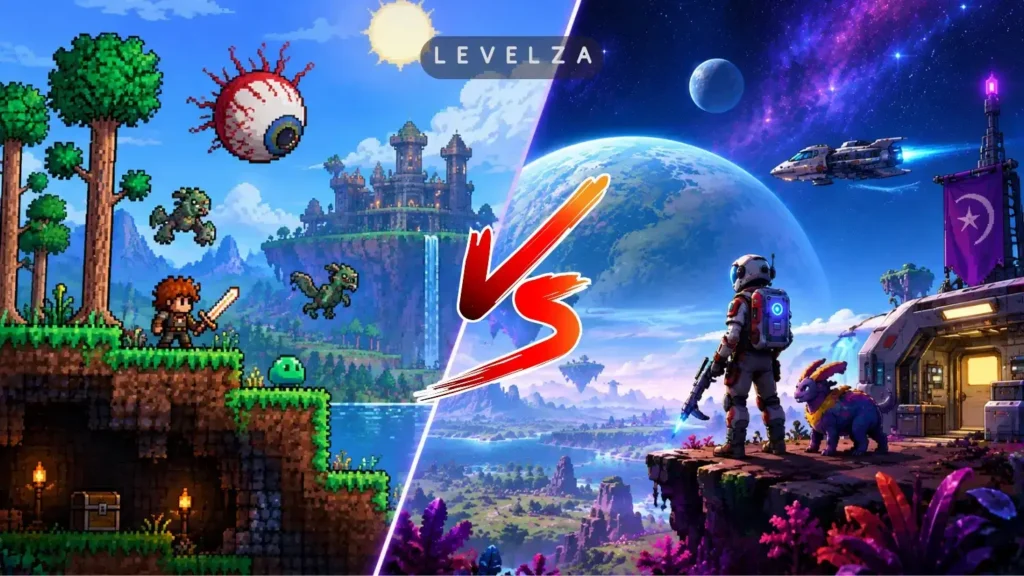


Comparing Terraria vs Starbound goes far beyond choosing between fantasy caverns and sci-fi spaceships. Both games share 2D pixel-art heritage and sandbox mining origins, but their mechanical priorities sit at opposite ends of the action-sandbox spectrum.
Mainstream comparisons often dismiss the debate as “Terraria in space,” ignoring the structural realities that actually separate the two: Terraria’s razor-sharp, mobility-heavy combat and boss choreography against Starbound’s relaxed multi-planet procedural galaxy, narrative campaign, and colony management systems. LEVELZA provides an exhaustive architectural and gameplay teardown here, anchored in the foundational Terraria platform engine.
QUICK VERDICT
- Verdict Summary: Terraria wins. While Starbound delivers superior galactic exploration and atmospheric world variety, Terraria remains the decisively stronger gaming experience due to tighter combat hitboxes, unmatched boss encounter design, deep class itemization, and ongoing official developer updates.
- Core Strength of Terraria: Masterful combat mechanics, fluid aerial mobility, 15+ progression-defining boss encounters, and an active official modding framework through tModLoader.
- Core Strength of Starbound: Infinite procedural planetary travel, personal customizable starships, species-specific lore, and sophisticated tenant colony systems.
Terraria vs Starbound: Head-to-Head Comparison Matrix
| Feature / Dimension | Terraria | Starbound | LEVELZA Analysis & Verdict |
|---|---|---|---|
| World Structure & Traversal Scale | Single bounded world (Small, Medium, Large) featuring dense vertical subterranean stratification. | Infinite procedural galaxy of planets (Lush, Desert, Volcanic, Alien) navigated via personal starship. | Starbound Wins: Delivers true interplanetary travel and galactic sandbox scale that a single-world container cannot match. |
| Combat Mechanics & Boss Encounter Design | High-speed, mobility-driven 4-class combat with 15+ progression-gated bosses featuring intricate bullet-hell phases. | Slower, floatier combat with dual-wielding and an energy bar system; instanced story dungeon bosses with scripted patterns. | Terraria Wins: Incomparably tighter hit-boxes, more responsive movement physics, and significantly superior boss encounter design. |
| Progression Arc & Narrative Structure | Fully emergent sandbox progression, where defeating specific bosses permanently alters world states through Hardmode. | Main storyline with fixed mission hubs at The Outpost, artifact scans, racial codex lore, and side quests. | Starbound Wins: Provides a structured narrative framework and rich sci-fi lore for players who dislike open-ended sandboxes. |
| Itemization, Weapons & Equipment Progression | Progressive 4-class crafting trees, thousands of distinct items, accessory reforging, and unique armor set bonuses. | Procedural randomized weapon drops, modular Matter Manipulator upgrades, and functional EPP environmental packs. | Terraria Wins: Vastly deeper equipment synergies, accessory tinkering, and distinct playstyle specialization across Melee, Ranged, Magic, and Summoner builds. |
| Building Mechanics & Base Colony Systems | Functional town NPC housing, pylon teleportation networks, and mechanical wire/actuator engineering. | Modular tenant colony deeds, automated rent collection, extensive decorative furniture variety, and starship upgrading. | Tie / Situational: Terraria excels at functional arena and farm engineering; Starbound excels at decorative sci-fi colony design and personal starship customization. |
| Developer Stewardship & Modding Longevity | Over a decade of continuous free updates from Re-Logic, with official 64-bit Steam integration through tModLoader (Calamity, Thorium). | Official vanilla development concluded by Chucklefish, with longevity sustained almost entirely by community mods like Frackin’ Universe. | Terraria Wins: Unrivaled developer loyalty, active platform patching, and native Steam mod loader integration provide superior long-term longevity. |
World Scope & Traversal: Single Stratified World vs. Infinite Star Systems
Subterranean Verticality vs. Planetary Hopping
Terraria confines players to a single bounded container, but packs it with tremendous vertical depth across five layered strata: Space, Surface, Underground, Caverns, and the Underworld. Every one of those layers exists within the same continuous world file.
Starbound trades that dense local subterranean exploration for a procedural universe instead. Players hop between distinct planets categorized by threat level — Gentle, Temperate, Radioactive, Frozen, Fiery — each carrying its own atmospheric hazards and biome variety spread across an effectively unlimited galaxy.
The Personal Starship vs. The Hellevator Transit Network
Terraria’s approach to travel logistics is physical terrain engineering. Reaching the Underworld efficiently means digging multi-thousand-tile vertical “Hellevators,” constructing minecart rail systems, and establishing regional Pylon networks for fast teleportation between biomes.
Starbound instead centers travel around an upgradeable personal spaceship that functions as a mobile home base, a teleporter hub, and a mobile crafting workshop simultaneously. That ship makes instant transit across star systems the default experience rather than something players have to engineer themselves.
Core Mechanics & Feature Differences
4-Class Build Specialization vs. Dual-Wield Sci-Fi Arsenal
Terraria structures character progression around four dedicated combat classes — Melee, Ranged, Magic, and Summoner — where armor sets and accessory reforges multiply damage, critical strike chance, and invulnerability frames in ways that compound across an entire loadout.
Starbound takes an unspecialized approach by comparison. It relies on a unified energy bar, dual-wielding one-handed weapons, and procedurally generated firearms that frequently feel floaty and imprecise during high-speed engagements, without the same depth of build-defining synergy.
Bullet-Hell Arenas vs. Instanced Story Dungeon Encounters
Terraria’s marquee bosses — Plantera, the Empress of Light, the Moon Lord — demand custom-built arena infrastructure, specialized mobility accessories like wings or the Master Ninja Gear dash, and genuinely reflex-heavy dodging under sustained pressure.
Starbound’s bosses, such as the Erchius Horror, Asra Nox, and The Ruin, instead take place inside scripted, instanced story missions that lean on environmental puzzle mechanics rather than raw combat agility. The two design philosophies are built around entirely different skills.
Platform Availability & Cross-Progression
Terraria’s developer stewardship has translated directly into platform reach. Re-Logic’s continuous free updates run from version 1.1 through 1.4.5 and beyond, spanning more than a decade of active post-launch development, and the game is available natively across PC, mobile, and every major console.
Starbound’s history under Chucklefish took a very different path. Official post-launch updates stalled after the game’s main development cycle concluded, leaving vanilla balance rough in places, and long-promised console ports have remained largely unreleased, confining the game almost entirely to PC, macOS, and Linux.
Modding infrastructure reflects this same gap. Terraria’s tModLoader is an official, 64-bit standalone engine distributed directly through Steam, supporting massive community total conversions such as Calamity, Thorium, and Fargo’s Mod. Starbound’s modding scene centers on the monolithic Frackin’ Universe mod through Steam Workshop, which is genuinely deep, but operates on top of a largely dormant vanilla base rather than an actively maintained one.
Pricing & Licensing Comparison
Both titles ship as one-time purchases with no subscription requirement, though the practical value proposition has shifted over time given each game’s update trajectory. Terraria’s price has effectively compounded in value through a decade of major free content drops that each rival the scope of a paid expansion elsewhere.
Starbound’s purchase price reflects a more fixed value proposition at this point, since official content additions have largely ceased and further depth now depends on installing community mods rather than waiting on new official updates.
TIP — CHOOSING THE RIGHT MODDING EXPERIENCE ACROSS BOTH GAMES
For Terraria, master the vanilla game through defeating the Moon Lord before installing tModLoader with the Calamity Mod for a significantly expanded endgame experience.
For Starbound, installing Frackin’ Universe is close to mandatory for veterans seeking deep crafting, complex biochemistry, and genuine progression depth — but be aware that it permanently alters save files, so back up an existing world first.