
In this Starbound review, LEVELZA examines whether Chucklefish’s galactic 2D sandbox RPG delivers lasting space exploration or whether floaty combat, repetitive quest loops, and a halted development cycle undermine its ambition.
Mainstream coverage mostly appeared around the 2016 launch window. Those reviews missed the later updates, the end of official development after the 1.4 release, and the game’s modern dependence on community modders to fix its progression.
LEVELZA evaluates procedural planet generation, engine performance, starship systems, and long-term ecosystem health across the full Starbound platform, so the verdict reflects the game as it exists today.
Starbound Review: Planetary Exploration and Quest Architecture
Exploration is the reason Starbound endures, and it is also where the game’s most visible weaknesses appear. LEVELZA evaluations found that the same systems producing the best early hours also produce the most repetition later.
The Procedural Galaxy: Atmospheric Grandeur vs. Planetary Sameness
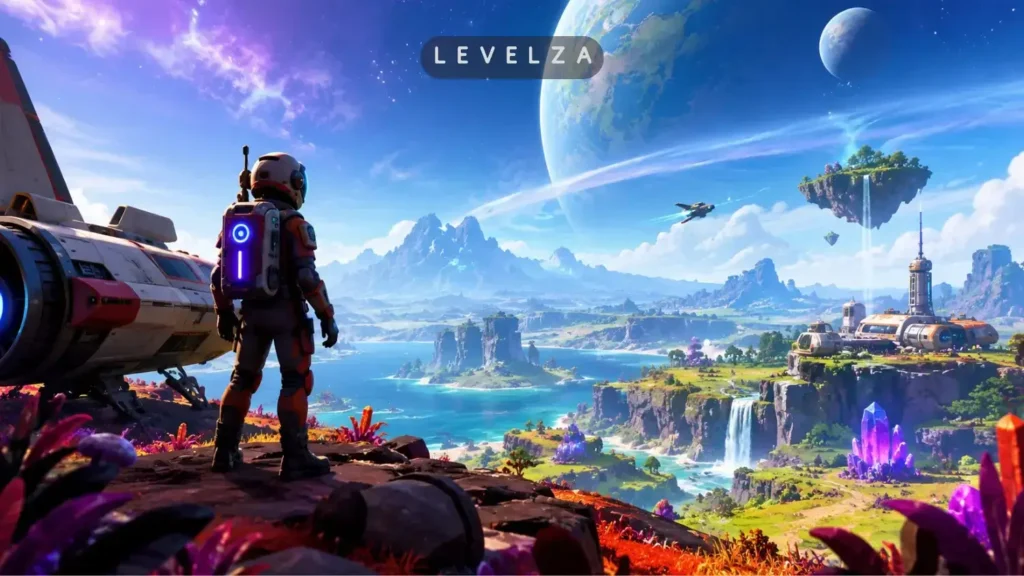
Travelling between Gentle, Radioactive, Frozen, and Volcanic star systems delivers a real sense of scale. Each threat tier changes what a player must carry, and weather events such as meteor showers and acid rain make surface trips feel unpredictable.
That impression fades with time. Subterranean structures and surface micro-dungeons reuse the same assets and layouts across different coordinates, so a veteran can identify a dungeon’s contents from its silhouette.
The variety is broad in biome and atmosphere but shallow in structure. Deterministic generation keeps every world stable and shareable, yet it does not guarantee that each one feels distinct.
The Protectorate Campaign and Outpost Scanning Fatigue
The main storyline opens with the destruction of Earth, which is among the strongest openings in the genre. The Outpost then becomes the hub for a sequence of artifact-gathering missions.
The mid-game settles into a loop of jumping to random planets, pressing N to scan cultural landmarks, and filling a quest gauge. Glitch castles, Avian temples, and Hylotl underwater cities are memorable the first time, but the objective stays identical.
Only after that gauge fills does the campaign open an instanced story dungeon. The dungeons are well designed, so the weakness lies in the connective tissue between them, not in the set pieces.
Combat Mechanics, Mobility & Technical Performance
Combat and engine behavior are the two areas where critical analysis is least forgiving. Both hold up in the early game and degrade as scale increases.
The Floaty Combat Reality
Compared with dedicated 2D action games, Starbound’s weapon handling feels loose. Jump physics are floaty, melee swing arcs are sluggish, and the absence of clear invulnerability frames disconnects outcomes from player skill.
Most encounters therefore resolve as stat checks. Better gear and armor tiers decide fights more than dodging or positioning does, which rewards preparation but not reflexes.
Boss fights suffer most from this. Attack patterns are readable, but the player’s response options are too blunt to make them feel like choreography.
Colony Rendering Bottlenecks and Engine Stutters
The lightweight 2D client boots easily on modest hardware, and a fresh universe runs with minimal overhead. That advantage narrows as a save grows.
Sprawling multi-tiered tenant colonies and dense lighting sources produce noticeable simulation lag and frame drops. This exposes the limits of an engine that handles large entity counts less gracefully than it handles a single explored cave.
The engine separates simulation from rendering, so physics stay consistent when frame rate dips. The cost appears as visible stutter, not broken behavior. Heavily modded worlds compound the effect, which makes performance the main practical constraint on ambitious builds.
Who It’s For / Who Should Skip It
LEVELZA evaluations point to three player types who will get the most from Starbound. Each of them values open-ended creation over tightly tuned action.
- Sci-fi sandbox builders who want an infinite procedural canvas for futuristic colonies, laboratory bases, and customized spaceships.
- Roleplayers and lore hunters who enjoy species worldbuilding, codex collecting, and distinct cultural dialogue.
- Modding enthusiasts ready to install total conversions such as Frackin’ Universe for deep technical crafting trees.
Three groups should skip it or wait. Their expectations conflict with the game’s design.
- Action-RPG purists who demand tight hitboxes, responsive dodging, and intricate boss choreography.
- Players who dislike fetch-and-scan objectives and will tire of the mid-game campaign loop.
- Mobile-only players, since no mobile port exists and console availability is limited.
Ready to repair your starship and brave the stars? Follow our step-by-step tutorial on How to Play Starbound to master starter crafting grids, locate Core Fragments, and explore alien worlds safely.
TIP — BUILDING A MODERN VANILLA-PLUS MOD LIST
Complete the vanilla campaign once to experience the core story as designed. Then add quality-of-life Steam Workshop mods, such as Instant Crafting, Container UI Improvements, and Enhanced Storage, to remove inventory bottlenecks.
Only after that foundation is stable should a player attempt a large overhaul like Frackin’ Universe. Back up the storage folder first, since overhauls cannot be cleanly reversed.